Benazir Bhutto (June 21, 1953, – December 27, 2007) twice Prime Minister of Pakistan (1988-1990; 1993-1996) was a Pakistani politician who chaired the Pakistan Peoples Party (PPP), a centre-left political party in Pakistan affiliated to the Socialist International. Bhutto was the first woman elected to lead a Muslim state, having been twice elected Prime Minister of Pakistan.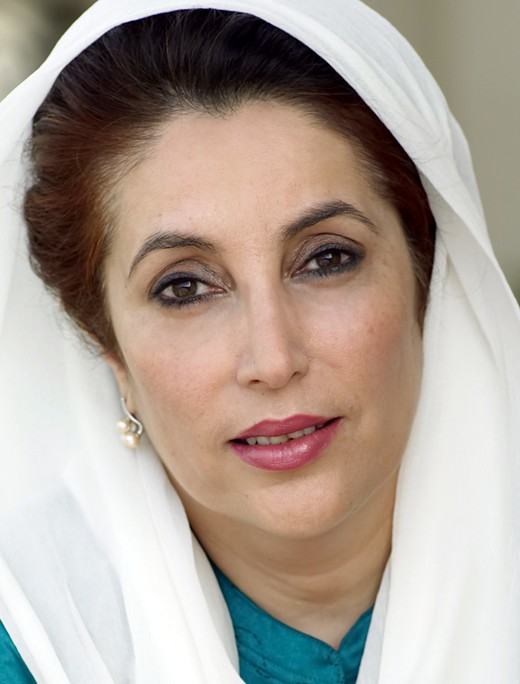
Bhutto was the eldest child of former prime minister Zulfikar Ali Bhutto, a Pakistani of Sindhi descent and Shia Muslim by faith, and Begum Nusrat Bhutto, a Pakistani of Iranian-Kurdish descent, of similarly Shia Muslim by faith. Her paternal grandfather was Sir Shah Nawaz Bhutto, who came to Larkana Sindh before partition from his native town of Bhatto Kalan, which was situated in the Indian state of Haryana.
Bhutto was sworn in for the first time in 1988 at the age of 35, but was removed from office 20 months later under the order of then-president Ghulam Ishaq Khan on grounds of alleged corruption. In 1993 Bhutto was re-elected but was again removed in 1996 on similar charges, this time by President Farooq Leghari. Bhutto went into self-imposed exile in Dubai in 1998.
Bhutto returned to Pakistan on 18 October 2007, after reaching an understanding with President Pervez Musharraf by which she was granted amnesty and all corruption charges were withdrawn. She was assassinated on December 27, 2007, after departing a PPP rally in the Pakistani city of Rawalpindi, two weeks before the scheduled Pakistani general election of 2008 where she was a leading opposition candidate. Serious questions have been raised about the govenment's version of events.
Education and personal life
Benazir Bhutto was born to Begum Nusrat Ispahani, and Zulfikar Ali Bhutto of a prominent Shia Muslim family of Larkana , in Karachi, Dominion of Pakistan on June 21, 1953. She attended the Lady Jennings Nursery School and then the Convent of Jesus and Mary in Karachi. After two years of schooling at the Rawalpindi Presentation Convent, she was sent to the Jesus and Mary Convent at Murree. She passed her O-level examinations at the age of 15. She then went on to complete her A-Levels at the Karachi Grammar School.
After completing her early education in Pakistan, she pursued her higher education in the United States. From 1969 to 1973 she attended Radcliffe College at Harvard University, where she obtained a Bachelor of Arts degree with cum laude honors in comparative government. She was also elected to Phi Beta Kappa. Bhutto would later call her time at Harvard "four of the happiest years of my life" and said it formed "the very basis of [her] belief in democracy". As Prime Minister, she arranged a gift from the Pakistani government to Harvard Law School.
The next phase of her education took place in the United Kingdom. Between 1973 and 1977 Bhutto studied Philosophy, Politics, and Economics at Lady Margaret Hall, Oxford, during which time she completed additional courses in International Law and Diplomacy.
In December 1976 she was elected president of the Oxford Union, becoming the first Asian woman to head the prestigious debating society.
On December 18, 1987 she married Asif Ali Zardari in Karachi. The couple had three children: Bilawal, Bakhtwar and Aseefa.
Family
Benazir Bhutto's father, former Prime Minister Zulfikar Ali Bhutto, was removed from office following a military coup in 1977 led by the then military chief General Muhammad Zia-ul-Haq, who imposed martial law but promised to hold elections within three months. But later, instead of fulfilling the promise of holding general elections, General Zia charged Mr. Bhutto with conspiring to murder the father of dissident politician Ahmed Raza Kasuri. Mr. Zulfikar Ali Bhutto was sentenced to death by the martial law court.
Despite the accusation being "widely doubted by the public", and despite many clemency appeals from foreign leaders, Zulfikar Ali Bhutto was hanged on 4 April 1979. Appeals for clemency were dismissed by acting President General Zia. Benazir Bhutto and her mother were held in a "police camp" until the end of May, after the execution.
In 1985, Benazir Bhutto's brother Shahnawaz was killed under suspicious circumstances in France. The killing of another of her brothers, Mir Murtaza, in 1996, contributed to destabilizing her second term as Prime Minister.
Prime Minister
Bhutto, who had returned to Pakistan after completing her studies, found herself placed under house arrest in the wake of her father's imprisonment and subsequent execution. Having been allowed in 1984 to return to the United Kingdom, she became a leader in exile of the PPP, her father's party, though she was unable to make her political presence felt in Pakistan until after the death of General Muhammad Zia-ul-Haq. She had succeeded her mother as leader of the PPP and the pro-democracy opposition to the Zia-ul-Haq regime.
On November 16, 1988, in the first open election in more than a decade, Bhutto's PPP won the largest bloc of seats in the National Assembly. Bhutto was sworn in as Prime Minister of a coalition government on December 2, becoming at age 35 the youngest person — and the first woman — to head the government of a Muslim-majority state in modern times. In 1989, she was awarded the Prize For Freedom by the Liberal International. Bhutto accomplishments during this time were in initiatives for nationalist reform and modernization, that some conservatives characterized as Westernization. Bhutto's government was dismissed in 1990 following charges of corruption, for which she never was tried. Zia's protégé Nawaz Sharif subsequently came to power. Bhutto was re-elected in 1993 but was dismissed three years later amid various corruption scandals by then president Farooq Leghari, who used the Eighth Amendment discretionary powers to dissolve the government. The Supreme Court affirmed President Leghari's dismissal in a 6-1 ruling.
After being dismissed by the then-president of Pakistan on charges of corruption, her party lost the October elections. She served as leader of the opposition whilst Nawaz Sharif served as Prime Minister for the next three years.
Elections were held again in October 1993 and her PPP coalition was victorious, returning Bhutto to office. She continued with her reform initiatives. In 1996 her government was once again dismissed on corruption charges. Criticism against Bhutto came from the Punjabi elites and powerful landlord families who opposed Bhutto. She blamed this opposition for the destabilization of Pakistan. Irshad Manji judged her attempts to modernize Pakistan a failure.
Policies for women
During the election campaigns the Bhutto government voiced its concern for women's social and health issues, including the issue of discrimination against women. Bhutto announced plans to establish women's police stations, courts, and women's development banks. Despite these plans, Bhutto did not propose any legislation to improve welfare services for women. During her election campaigns, she promised to repeal controversial laws (such as Hudood and Zina ordinances) that curtail the rights of women in Pakistan, but the party did not fulfill these promises during her tenures as Prime Minister, due to immense pressure from the opposition.
After Bhutto's stints as Prime Minister, during General Musharraf's regime, her party did initiate legislation to repeal the Zina ordinance. These efforts were defeated by the right-wing religious parties that dominated the legislatures at the time.
Bhutto was an active and founding member of the Council of Women World Leaders, a network of current and former prime ministers and presidents.
Policy on Taliban
The Taliban took power in Kabul in September 1996. It was during Bhutto's rule that the Taliban gained prominence in Afghanistan. She, like many leaders at the time, viewed the Taliban as a group that could stabilize Afghanistan and enable trade access to the Central Asian republics, according to author Stephen Coll. He claims that like the U.S., her government provided military and financial support for the Taliban, even sending a small unit of the Pakistani army into Afghanistan.
More recently, she took an anti-Taliban stance, and condemned terrorist acts allegedly committed by the Taliban and their supporters.
Exile
Bhutto went into self-imposed exile in Dubai in 1998.
Charges of corruption
French, Polish, Spanish, and Swiss documents have fueled the charges of corruption against Bhutto and her husband. Bhutto and her husband faced a number of legal proceedings, including a charge of laundering money through Swiss banks. Her husband, Asif Ali Zardari, spent eight years in prison on similar corruption charges. Zardari, released from jail in 2004, has suggested that his time in prison involved torture; human rights groups have supported his claim that his rights were violated.
A 1998 New York Times investigative report indicates that Pakistani investigators have documents that uncover a network of bank accounts, all linked to the family's lawyer in Switzerland, with Asif Zardari as the principal shareholder. According to the article, documents released by the French authorities indicated that Zardari offered exclusive rights to Dassault, a French aircraft manufacturer, to replace the air force's fighter jets in exchange for a 5% commission to be paid to a Swiss corporation controlled by Zardari. The article also said a Dubai company received an exclusive license to import gold into Pakistan for which Asif Zardari received payments of more than $10 million into his Dubai-based Citibank accounts. The owner of the company denied that he had made payments to Zardari and claims the documents were forged. Bhutto maintained that the charges leveled against her and her husband were purely political. An Auditor General of Pakistan (AGP) report supports Bhutto's claim. It presents information suggesting that Benazir Bhutto was ousted from power in 1990 as a result of a witch hunt approved by then-president Ghulam Ishaq Khan. The AGP report says Khan illegally paid legal advisers 28 million Rupees to file 19 corruption cases against Bhutto and her husband in 1990-92.
The assets held by Bhutto and her husband have been scrutinized. The prosecutors have alleged that their Swiss bank accounts contain £740 million. Zardari also bought a neo-Tudor mansion and estate worth over £4 million in Surrey, England, UK. The Pakistani investigations have tied other overseas properties to Zardari's family. These include a $2.5 million manor in Normandy owned by Zardari's parents, who had modest assets at the time of his marriage. Bhutto denied holding substantive overseas assets.
Switzerland
On July 23, 1998, the Swiss Government handed over documents to the government of Pakistan which relate to corruption allegations against Benazir Bhutto and her husband. The documents included a formal charge of money laundering by Swiss authorities against Zardari. The Pakistani government had been conducting a wide-ranging inquiry to account for more than $13.7 million frozen by Swiss authorities in 1997 that was allegedly stashed in banks by Bhutto and her husband. The Pakistani government recently filed criminal charges against Bhutto in an effort to track down an estimated $1.5 billion she and her husband are alleged to have received in a variety of criminal enterprises. The documents suggest that the money Zardari was alleged to have laundered was accessible to Benazir Bhutto and had been used to buy a diamond necklace for over $175,000. The PPP has responded by flatly denying the charges, suggesting that Swiss authorities have been misled by false evidence provided by Islamabad.
On August 6, 2003, Swiss magistrates found Bhutto and her husband guilty of money laundering. They were given six-month suspended jail terms, fined $50,000 each and were ordered to pay $11 million to the Pakistani government. The six-year trial concluded that Bhutto and Zardari deposited in Swiss accounts $10 million given to them by a Swiss company in exchange for a contract in Pakistan. The couple said they would appeal. The Pakistani investigators say Zardari opened a Citibank account in Geneva in 1995 through which they say he passed some $40 million of the $100 million he received in payoffs from foreign companies doing business in Pakistan. In October 2007, Daniel Zappelli, chief prosecutor of the canton of Geneva, said he received the conclusions of a money laundering investigation against former Pakistani Prime Minister Benazir Bhutto on Monday, October 29, but it was unclear whether there would be any further legal action against her in Switzerland.
Poland
The Polish Government has given Pakistan 500 pages of documentation relating to corruption allegations against Benazir Bhutto and her husband. These charges are in regard to the purchase of 8,000 tractors in a 1997 deal. According to Pakistani officials, the Polish papers contain details of illegal commissions paid by the tractor company in return for agreeing to their contract. It was alleged that the arrangement "skimmed" Rs 103 mn rupees ($2 million) in kickbacks. "The documentary evidence received from Poland confirms the scheme of kickbacks laid out by Asif Zardari and Benazir Bhutto in the name of (the) launching of Awami tractor scheme," APP said. Bhutto and Asif Ali Zardari allegedly received a 7.15% commission on the purchase through their front men, Jens Schlegelmilch and Didier Plantin of Dargal S.A., who received about $1.969 million for supplying 5,900 Ursus tractors.
France
Potentially the most lucrative deal alleged in the documents involved the effort by Dassault Aviation, a French military contractor. French authorities indicated in 1998 that Bhutto's husband, Zardari, offered exclusive rights to Dassault to replace the air force’s fighter jets in exchange for a five percent commission to be paid to a corporation in Switzerland controlled by Zardari.
At the time, French corruption laws forbade bribery of French officials but permitted payoffs to foreign officials, and even made the payoffs tax-deductible in France. However, France changed this law in 2000.
Western Asia
In the largest single payment investigators have uncovered, a gold bullion dealer in Western Asia was alleged to have deposited at least $10 million into one of Zardari's accounts after the Bhutto government gave him a monopoly on gold imports that sustained Pakistan's jewellery industry. The money was allegedly deposited into Zardari's Citibank account in Dubai. Pakistan's Arabian Sea coast, stretching from Karachi to the border with Iran, has long been a gold smugglers' haven. Until the beginning of Bhutto's second term, the trade, running into hundreds of millions of dollars a year, was unregulated, with slivers of gold called biscuits, and larger weights in bullion, carried on planes and boats that travel between the Persian Gulf and the largely unguarded Pakistani coast.
Shortly after Bhutto returned as prime minister in 1993, a Pakistani bullion trader in Dubai, Abdul Razzak Yaqub, proposed a deal: in return for the exclusive right to import gold, Razzak would help the government regularize the trade. In November 1994, Pakistan's Commerce Ministry wrote to Razzak informing him that he had been granted a license that made him, for at least the next two years, Pakistan's sole authorized gold importer. In an interview in his office in Dubai, Razzak acknowledged that he had used the license to import more than $500 million in gold into Pakistan, and that he had travelled to Islamabad several times to meet with Bhutto and Zardari. But he denied that there had been any corruption or secret deals. "I have not paid a single cent to Zardari," he said. Razzak claims that someone in Pakistan who wished to destroy his reputation had contrived to have his company wrongly identified as the depositor. "Somebody in the bank has cooperated with my enemies to make false documents," he said.
Bhutto's niece and others have publicly accused Bhutto of complicity in the killing of her brother Murtaza Bhutto in 1996 by uniformed police officers whilst she was Prime Minister.
Early 2000s in exile
In 2002, Pakistani president Pervez Musharraf amended Pakistan's constitution to ban prime ministers from serving more than two terms. This disqualified Bhutto from ever holding the office again. This move was widely considered to be a direct attack on former prime ministers Benazir Bhutto and Nawaz Sharif. On August 3, 2003, Bhutto became a member of Minhaj ul Quran International (An international Muslim educational and welfare organization).
Whilst living in Dubai, United Arab Emirates she cared for her three children and her mother, who was suffering from Alzheimer's disease, traveling to give lectures and keeping in touch with the PPP's supporters. They were reunited with her husband in December 2004 after more than five years. In 2006, Interpol issued a request for the arrest of Bhutto and her husband on corruption charges, at the request of Pakistan. The Bhuttos questioned the legality of the requests in a letter to Interpol. On 27 January 2007 she was invited by the United States to speak to President George W. Bush and Congressional and State Department officials. Bhutto appeared as a panellist on the BBC TV programme Question Time in the UK in March 2007. She has also appeared on BBC current affairs programme Newsnight on several occasions. She rebuffed comments made by Muhammad Ijaz-ul-Haq in May 2007 regarding the knighthood of Salman Rushdie, citing that he was calling for the assassination of foreign citizens.
Bhutto had declared her intention to return to Pakistan within 2007, which she did, in spite of Musharraf's statements of May 2007 about not allowing her to return ahead of the country's general election, due late 2007 or early 2008. It was speculated that she may have been offered the office of Prime Minister again.
Arthur Herman, a U.S. historian, in a controversial letter published in The Wall Street Journal on 14 June 2007, in response to an article by Bhutto highly critical of the president and his policies, has described her as "One of the most incompetent leaders in the history of South Asia", and asserted that she and other elites in Pakistan hate Musharraf because he was a muhajir, the son of one of millions of Indian Muslims who fled to Pakistan during partition in 1947. Herman has claimed, "Although it was muhajirs who agitated for the creation of Pakistan in the first place, many native Pakistanis view them with contempt and treat them as third-class citizens."
Nonetheless, as of mid-2007, the US appeared to be pushing for a deal in which Musharraf would remain as president but step down as military head, and either Bhutto or one of her nominees would become prime minister.
On July 11, 2007, the Associated Press, in an article about the possible aftermath of the Red Mosque incident, wrote:
Benazir Bhutto, the former prime minister and opposition leader expected by many to return from exile and join Musharraf in a power-sharing deal after year-end general elections, praised him for taking a tough line on the Red Mosque. I'm glad there was no cease-fire with the militants in the mosque because cease-fires simply embolden the militants," she told Britain's Sky TV on Tuesday. "There will be a backlash, but at some time we have to stop appeasing the militants."
This remark about the Red Mosque was seen with dismay in Pakistan as reportedly hundreds of young students were burned to death and remains are untraceable and cases are being heard in Pakistani supreme court as a missing persons issue. This and subsequent support for Musharaf led Elder Bhutto's comrades like Khar to criticize her publicly.
Bhutto however advised Musharraf in an early phase of the latter's quarrel with the Chief Justice, to restore him. Her PPP did not capitalize on its CEC member, Aitzaz Ahsan, the chief Barrister for the Chief Justice, in successful restoration. Rather he was seen as a rival and was isolated.
2002 election
The Bhutto-led PPP secured the highest number of votes (28.42%) and eighty seats (23.16%) in the national assembly in the October 2002 general elections. Pakistan Muslim League (N) (PML-N) managed to win eighteen seats only. Some of the elected candidates of PPP formed a faction of their own, calling it PPP-Patriots which was being led by Makhdoom Faisal Saleh Hayat, the former leader of Bhutto-led PPP. They later formed a coalition government with Musharraf's party, PML-Q.
Return to Pakistan and assassination attempts
Possible deal with the Musharraf Government
In summer 2002 Musharraf implemented a two-term limit on Prime Ministers. Both Bhutto and Musharraf's other chief rival, Nawaz Sharif, have already served two terms as Prime Minister. Musharraf's allies in parliament, especially the PMLQ, are unlikely to reverse the changes to allow Prime Ministers to seek third terms, nor to make particular exceptions for either Bhutto or Sharif.
In July 2007, some of Bhutto's frozen funds were released. Bhutto continued to face significant charges of corruption. In an 8 August 2007 interview with the Canadian Broadcasting Corporation, Bhutto revealed the meeting focused on her desire to return to Pakistan for the 2008 elections, and of Musharraf retaining the Presidency with Bhutto as Prime Minister. On August 29, 2007, Bhutto announced that Musharraf would step down as chief of the army. On 1 September Bhutto vowed to return to Pakistan "very soon", regardless of whether or not she reached a power-sharing deal with Musharraf before then.
On September 17, 2007, Bhutto accused Musharraf's allies of pushing Pakistan into crisis by their refusal to permit democratic reforms and power-sharing. A nine-member panel of Supreme Court judges deliberated on six petitions (including one from Jamaat-e-Islami, Pakistan's largest Islamic group) asserting that Musharraf be disqualified from contending for the presidency of Pakistan. Bhutto stated that her party could join one of the opposition groups, potentially that of Nawaz Sharif. Attorney-general Malik Mohammed Qayyum stated that, pendente lite, the Election Commission was "reluctant" to announce the schedule for the presidential vote. Bhutto's party's Farhatullah Babar stated that the Constitution of Pakistan could bar Musharraf from being elected again because he was already chief of the army: "As Gen. Musharraf was disqualified from contesting for President, he has prevailed upon the Election Commission to arbitrarily and illegally tamper with the Constitution of Pakistan."
Musharraf prepared to switch to a strictly civilian role by resigning from his position as commander-in-chief of the armed forces. He still faced other legal obstacles to running for re-election. On October 2, 2007, Gen. Musharraf named Lt. Gen. Ashfaq Kayani, as vice chief of the army starting October 8 with the intent that if Musharraf won the presidency and resigned his military post, Kayani would become chief of the army. Meanwhile, Minister Sheikh Rashid Ahmed stated that officials agreed to grant Benazir Bhutto amnesty versus pending corruption charges. She has emphasized the smooth transition and return to civilian rule and has asked Pervez Musharaf to shed uniform. On October 5, 2007, Musharraf signed the National Reconciliation Ordinance, giving amnesty to Bhutto and other political leaders—except exiled former premier Nawaz Sharif—in all court cases against them, including all corruption charges. The Ordinance came a day before Musharraf faced the crucial presidential poll. Both Bhutto's opposition party, the PPP, and the ruling PMLQ, were involved in negotiations beforehand about the deal. In return, Bhutto and the PPP agreed not to boycott the Presidential election. On October 6, 2007, Musharraf won a parliamentary election for President. However, the Supreme Court ruled that no winner can be officially proclaimed until it finishes deciding on whether it was legal for Musharraf to run for President whilst remaining Army General. Bhutto's PPP party did not join the other opposition parties' boycott of the election, but did abstain from voting. Later, Bhutto demanded security coverage on-par with the President's. Bhutto also contracted foreign security firms for her protection.
Return
Bhutto was well aware of the risk to her own life that might result from her return from exile to campaign for the leadership position. In an interview on 28 September 2007 with reporter Wolf Blitzer of CNN, she readily admitted the possibility of attack on herself.
After eight years in exile in Dubai and London, Bhutto returned to Karachi on October 18, 2007 to prepare for the 2008 national elections.
En route to a rally in Karachi on October 18, 2007, two explosions occurred shortly after Bhutto had landed and left Jinnah International Airport. She was not injured but the explosions, later found to be a suicide-bomb attack, killed 136 people and injured at least 450. The dead included at least 50 of the security guards from her PPP who had formed a human chain around her truck to keep potential bombers away, as well as 6 police officers. A number of senior officials were injured. Bhutto was escorted unharmed from the scene.
Bhutto later claimed that she had warned the Pakistani government that suicide bomb squads would target her upon her return to Pakistan and that the government had failed to act. She was careful not to blame Pervez Musharraf for the attacks, accusing instead "certain individuals [within the government] who abuse their positions, who abuse their powers" to advance the cause of Islamic militants. Shortly after the attempt on her life, Bhutto wrote a letter to Musharraf naming four persons whom she suspected of carrying out the attack. Those named included Chaudhry Pervaiz Elahi, a rival PML-Q politician and chief minister of Pakistan's Punjab province, Hamid Gul, former director of the Inter-Services Intelligence, and Ijaz Shah, the director general of the Intelligence Bureau, another of the country’s intelligence agencies. All those named are close associates of General Musharraf. Bhutto has a long history of accusing parts of the government, particularly Pakistan’s premier military intelligence agencies, of working against her and her party because they oppose her liberal, secular agenda. Bhutto claimed that the ISI has for decades backed militant Islamic groups in Kashmir and in Afghanistan. She was protected by her vehicle and a "human cordon" of supporters who had anticipated suicide attacks and formed a chain around her to prevent potential bombers from getting near her. The total number of injured, according to PPP sources, stood at 1000, with at least 160 dead (The New York Times claims 134 dead and about 450 injured).
A few days later, Bhutto's lawyer Senator Farooq H. Naik said he received a letter threatening to kill his client. The letter also claims to have links with al-Qaeda and followers of Osama bin Laden.
2007 State of Emergency and response
On November 3, 2007, President Pervez Musharraf declared a state of emergency, citing actions by the Supreme Court of Pakistan and religious extremism in the nation. Bhutto returned to the country, interrupting a visit to family in Dubai. She was greeted by supporters chanting slogans at the airport. After staying in her plane for several hours she was driven to her home in Lahore, accompanied by hundreds of supporters. Whilst acknowledging that Pakistan faced a political crisis, she noted that Musharraf's declaration of emergency, unless lifted, would make it very difficult to have fair elections. She commented that "The extremists need a dictatorship, and dictatorship needs extremists."
On November 8, 2007, Bhutto was placed under house arrest just a few hours before she was due to lead and address a rally against the state of emergency.
During a telephone interview with NPR Ms. Bhutto said "I have freedom of movement within the house. I don't have freedom of movement outside the house. They've got a heavy police force inside the house, and we've got a very heavy police force - 4,000 policemen around the four walls of my house, 1,000 on each. They've even entered the neighbors' house. And I was just telling one of the policemen, I said 'should you be here after us? Shouldn't you be looking for Osama bin Laden?' And he said, 'I'm sorry, ma'am, this is our job. We're just doing what we are told.'"
The following day, the Pakistani government announced that Bhutto's arrest warrant had been withdrawn and that she would be free to travel and to appear at public rallies. However, leaders of other opposition political parties remained prohibited from speaking in public.
Preparation for 2008 elections
On November 24, 2007, Bhutto filed her nomination papers for January's Parliamentary elections; two days later, she filed papers in the Larkana constituency for two regular seats. She did so as former Pakistani Prime Minister Nawaz Sharif, following seven years of exile in Saudi Arabia, made his much-contested return to Pakistan and bid for candidacy.
When sworn in again on November 30, 2007, this time as a civilian president after relinquishing his post as military chief, Musharraf announced his plan to lift the Pakistan's state of emergency rule on December 16. Bhutto welcomed the announcement and launched a manifesto outlining her party's domestic issues. Bhutto told journalists in Islamabad that her party, the PPP, would focus on "the five E's": employment, education, energy, environment, equality.
On December 4, 2007, Bhutto met with Nawaz Sharif to publicize their demand that Musharraf fulfill his promise to lift the state of emergency before January's parliamentary elections, threatening to boycott the vote if he failed to comply. They promised to assemble a committee which would present to Musharraf the list of demands upon which their participation in the election was contingent.
On December 8, 2007, three unidentified gunmen stormed Bhutto's PPP office in the southern western province of Baluchistan. Three of Bhutto's supporters were killed.
Assassination
On December 27, 2007, Bhutto was killed whilst leaving a campaign rally for the PPP at Liaquat National Bagh, where she had given a spirited address to party supporters in the run-up to the January 2008 parliamentary elections. After entering her bulletproof vehicle, Bhutto stood up through its sunroof to wave to the crowds. At this point, a gunman standing behind and to the left of the vehicle fired three shots at her with a pistol (still photographs exist which show a man in dark glasses holding up a handgun, and film footage has also been shown in which a pistol is seen firing a number of shots whose muzzle-flashes are clearly visible). Immediately afterwards, someone in the area (perhaps the white-robed individual visible in several still photographs standing close to the gunman) detonated explosives stored about their person, killing approximately 20 people. Bhutto was critically wounded and was rushed to Rawalpindi General Hospital. She was taken into surgery at 17:35 local time, and pronounced dead at 18:16.
Bhutto's body was flown to her hometown of of Garhi Khuda Bakhsh in Larkana District, Sindh, and was buried next to her father in the family mausoleum at a ceremony attended by hundreds of thousands of mourners.
There was some disagreement about the exact cause of death. Bhutto's husband refused to permit an autopsy or post-mortem examination to be carried out. On December 28, 2007, the Interior Ministry of Pakistan stated that "Bhutto was killed when she tried to duck back into the vehicle, and the shock waves from the blast knocked her head into a lever attached to the sunroof, fracturing her skull". However, a hospital spokesman stated earlier that she had suffered shrapnel wounds to the head and that this was the cause of her death. Bhutto's aides have also disputed the Interior Ministry's account.
Al-Qaeda commander Mustafa Abu al-Yazid claimed responsibility for the attack, describing Bhutto as "the most precious American asset." The Pakistani government also stated that it had proof that al-Qaeda was behind the assassination. A report for CNN stated: "the Interior Ministry also earlier told Pakistan's GEO-TV that the suicide bomber belonged to Lashkar i Jhangvi — an al-Qaeda-linked militant group that the government has blamed for hundreds of killings". The government of Pakistan claimed Baitullah Mehsud was the mastermind behind the assassination. Lashkar i Jhangvi, a Wahabi Muslim extremist organization affiliated with al-Qaeda that also attempted in 1999 to assassinate former Prime Minister Nawaz Sharif, is alleged to have been responsible for the killing of the 54-year-old Bhutto along with approximately 20 bystanders, however this is vigorously disputed by the Bhutto family, by the PPP that Bhutto had headed and by Baitullah Mehsud.
On 30 December 2007, the Central Election Commission (CEC) approved the delegation of the succession that Asif Ali Zardari had been given to lead the PPP. It was unclear what role Bilawal would play.
Reaction in Pakistan
After the assassination, there were initially a number of riots resulting in approximately 20 deaths, of whom three were police officers. Around 250 cars were burnt; angry and upset supporters of Bhutto threw rocks outside the hospital where she was being held. Through Saturday, December 29, 2007, the Pakistani government said rioters had wrecked nine election offices, 176 banks, 34 gas stations, 72 train cars, 18 rail stations, and hundreds of cars and shops. Nawaz Sharif, the leader of the rival opposition party Pakistan Muslim League (N), stated that "This is a tragedy for her party, and a tragedy for our party and the entire nation." Musharraf called for a three day mourning period after Bhutto's assassination on December 27, 2007.
On December 29, 2007 an unnamed senior official told Time magazine that Benazir Bhutto's 19-year-old son Bilawal Bhutto would on December 30, 2007 be made Benazir's successor as the leader of the PPP. However, the BBC reported that there were three possible contenders to the leadership of the PPP. Depending on the will of the late Bhutto, the three possible contenders are Bhutto's widower Asif Ali Zardari who had a relative role to play during her two terms as Prime Minister; however, Zardari was convicted with several corruption charges and was sent to jail where he served an eight-year sentence.
Bhutto's son Bilawal Bhutto, who is currently 19 years old and is studying in his first year at Oxford University, although he is considered by some PPP members to be too young.
Makhdoom Amin Fahim, a senior member of the party, who has been Bhutto's aide since her first term as Prime Minister.
On December 30, 2007 the late Bhutto's will was read out to the leading members in her party the PPP. The will stated that her husband Asif Ali Zardari should be leader of the party. Zardari said that under the circumstances, a Bhutto needed to run the party. It has been announced in Pakistan that Bhutto's son Bilawal Bhutto Zardari will take the cermonial role of the PPP, whilst Asif Ali Zardari will take on day-to-day work. Bilawal said that his mother told him that "democracy would be the best revenge." Zardari called on the British government to help in an investigation into his late wife's death; at the same time, Zardari announced that his children ceremonially have changed their names to "Bhutto Zardari." He also announced that the family would not reveal a possible candidate to stand as Prime Minister, but rather wanted the name on the polls to read Benazir Bhutto and only decide the real candidate if she won the majority of the votes.
On December 30, the Pakistan Peoples Party (the party which she has been head of) called the for the UK Government and the UN to help and conduct the investigation of her death.
International reaction
The international reaction to Bhutto's assassination was of strong condemnation across the international community. The UN Security Council held an emergency meeting and unanimously condemned the assassination. Arab League Secretary General Amr Moussa stated that, "We condemn this assassination and terrorist act, and pray for God Almighty to bless her soul." India's Prime Minister Manmohan Singh said he was "deeply shocked and horrified to hear of the heinous assassination of Mrs. Benazir Bhutto. [...] My heartfelt condolences go to her family and the people of Pakistan who have suffered a grievous blow." British Prime Minister Gordon Brown stated, "Benazir Bhutto may have been killed by terrorists but the terrorists must not be allowed to kill democracy in Pakistan and this atrocity strengthens our resolve that terrorists will not win there, here or anywhere in the world." European Commission President José Manuel Barroso condemned the assassination as "an attack against democracy and against Pakistan," and "[hopes] that Pakistan will remain firmly on track for return to democratic civilian rule." U.S. President George W. Bush condemned the assassination as a "cowardly act by murderous extremists," and encouraged Pakistan to "honor Benazir Bhutto's memory by continuing with the democratic process for which she so bravely gave her life." Vatican Secretary of State Tarcisio Bertone expressed the sadness of Pope Benedict XVI, saying that "the Holy Father expresses sentiments of deep sympathy and spiritual closeness to the members of her family and to the entire Pakistani nation." Chinese Foreign Ministry spokesperson Qin Gang said that China was "shocked at the killing of Pakistan's opposition leader Benazir Bhutto" and "strongly condemns the terrorist attack."
Benazir Bhutto's books
Benazir Bhutto, (1983), Pakistan: The gathering storm, Vikas Pub. House, ISBN 0706924959
Benazir Bhutto (1989). Daughter of the East. Hamish Hamilton. ISBN 0-241-12398-4.
Daughter of the East was also released as:
Benazir Bhutto (1989). Daughter of Destiny: An Autobiography. Simon & Schuster. ISBN 0-671-66983-4.
At the time of Bhutto's death, the manuscript for her fourth book, to be called Reconciliation: Islam, Democracy and the West, had been received by HarperCollins. The book, written with Mark Siegel, is expected to be published in February 2008.
Books about Benazir Bhutto
W.F.Pepper, (1983), Benazir Bhutto, WF Pepper, ISBN 0946781001
Rafiq Zakaria (1990). The Trial of Benazir. Sangam Books. ISBN 0-861-32265-7.
Katherine M. Doherty, Caraig A. Doherty , (1990), Benazir Bhutto (Impact Biographies Series), Franklin Watts, ISBN 0531109364
Rafiq Zakaria, (1991), The Trial of Benazir Bhutto: An Insight into the Status of Women in Islam, Eureka Pubns, ISBN 9679783200
Diane Sansevere-Dreher, (1991), Benazir Bhutto (Changing Our World Series), Bantam Books (Mm), ISBN 0553158570
Christina Lamb, (1992), Waiting for Allah, Penguin Books Ltd, ISBN 0140143343
M. Fathers, (1992), Biography of Benazir Bhutto, W.H. Allen / Virgin Books, ISBN 024554965X
Elizabeth Bouchard, (1994), Benazir Bhutto: Prime Minister (Library of Famous Women), Blackbirch Pr Inc, ISBN 1567110274
Iqbal Akhund, (2000), Trial and Error: The Advent and Eclipse of Benazir Bhutto, OUP Pakistan, ISBN 0195791606
Libby Hughes, (2000), Benazir Bhutto: From Prison to Prime Minister, Backinprint.Com, ISBN 0595003885
Iqbal Akhund, (2002), Benazir Hukoomat: Phela Daur, Kia Khoya, Kia Paya?, OUP Pakistan, ISBN 0195794214
Mercedes Anderson, (2004), Benazir Bhutto (Women in Politics), Chelsea House Publishers, ISBN 0791077322
Mary Englar, (2007), Benazir Bhutto: Pakistani Prime Minister and Activist, Compass Point Books, ISBN 0756517982
Ayesha Siddiqa Agha, (2007), Military Inc.: Inside Pakistan's Military Economy, Pluto Press, ISBN 0745325459
Other related publications
Abdullah Malik, (1988), Bhutto se Benazir tak: Siyasi tajziye, Maktabah-yi Fikr o Danish, ASIN B0000CRQJH
Bashir Riaz, (2000), Blind justice, Fiction House, ASIN B0000CPHP8
Khatm-i Nabuvat, ASIN B0000CRQ4A
Mujahid Husain, (1999), Kaun bara bad °unvan: Benazir aur Navaz Sharif ki bad °unvaniyon par tahqiqati dastavez, Print La'in Pablisharz, ASIN B0000CRPC3
Ahmad Ejaz, (1993), Benazir Bhutto's foreign policy: A study of Pakistan's relations with major powers, Classic, ASIN B0000CQV0Y
Lubna Rafique, (1994), Benazir & British press, 1986-1990, Gautam, ASIN B0000CP41S
Sayyid Afzal Haidar, (1996), Bhutto trial, National Commission on History & Culture, ASIN B0000CPBFX
Mumtaz Husain Bazmi, (1996), Zindanon se aivanon tak, al-Hamd Pablikeshanz, ASIN B0000CRPOT
Unknown author, (1996), Napak sazish: Tauhin-i risalat ki saza ko khatm karne ka benazir sarkari mansubah, Intarnaishnal Institiyut af Tahaffuz-i


 she performed in a Portuguese marching band. Furtado has acknowledged her family as the source of her strong work ethic; she spent eight summers working as a chambermaid with her mother, who was a housekeeper in Victoria. She has stated that coming from a working class background has shaped her identity in a positive way.